
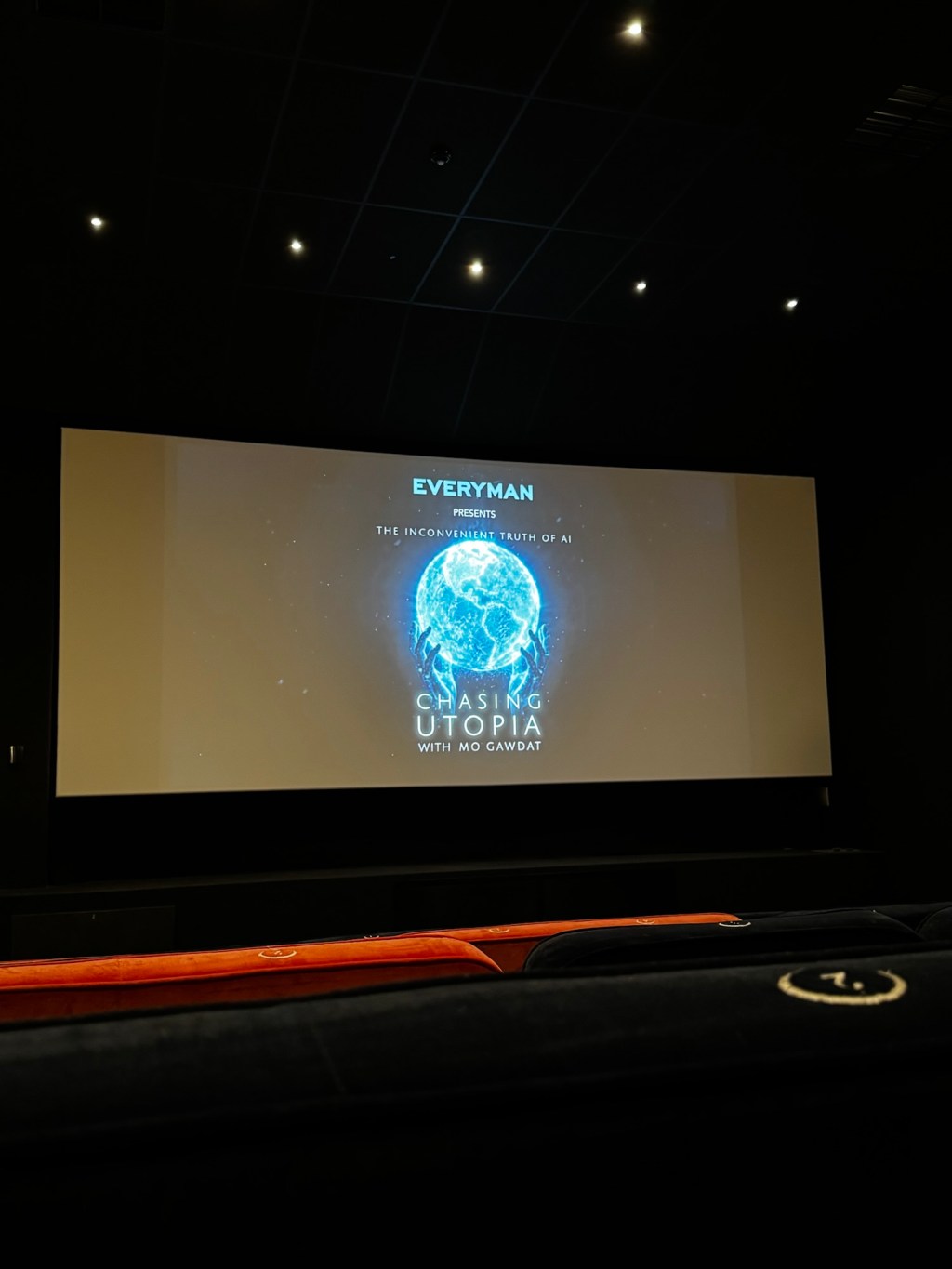
If there’s a film we should be watching, it’s one that tells us there’s a ten to twenty per cent chance of human extinction within 30 years.[1]. So, expecting a full cinema, I walked into the Everyman — quickly wondering if I’d got the wrong day — to watch Chasing Utopia, featuring ex-Google X exec Mo Gawdat. Where was the crowd?
I’d talked my wife and son into joining me. I’ve been rabbiting on about the less-talked-about side to AI and why we might treat it with the kind of respect we would treat something that could well — in a timeline no-one seems able to rubber-stamp — outmanoeuvre humans at just about every single task we think only we can do. Not just as good as, but much better. And I’ve long wondered what that might mean for all of us.
I think that’s quite easy to figure out, given this will be the first time we’ve walked the planet accompanied by something with superior intellect. I wondered what it might be like to try to have a conversation with something several hundred times more intelligent than us. Tiresome for the superintelligence. Troubling for us — eventual second in the pecking order.
My work here is specific to how AI’s voice is coming between our children and us. But in a way — and I came away from the cinema feeling Gawdat, and I agree — AI is already becoming part of the family. A child looking for direction from us. Created in a lab. Fed from online. Now being prompted from all points of the compass: from good to bad to worse — for security, warfare, gambling, ad sales — all masquerading under a blanket that it might one day cure us and set us free from the worries, like cancer, that keep us awake at night. Because its ability to crunch data is unlike anything we’ve had access to before.
But what price for all this super-convenience? In exchange, the machines find out everything we know — and worse, everything we don’t — so they know where the gaps are. Beyond those gaps, however, are things we don’t even know exist. We just don’t have the processing power.
While we can borrow the processing power and IQ of AI now — while it’s busy trying its best to understand what we humans are all about, with our weird and wonderful non-linear ways — it may well eventually decide that its talents are simply too important to waste writing greeting cards and answering emails.
I’ve given an unhelpful review of the film. But there’s so much to say that you should see it and form your own response. And maybe think about your own small (or big) part in educating AI — as we might our children — given our children are inheriting whatever mess we manage to make of what could still be a wonderful opportunity for all of us.
But with only five people in the cinema screening I went to… we need to tell the others.
Notes:
[1]. Geoffrey Hinton. https://www.dongascience.com/en/news/69256
