The Parenting Blind Spot
Raising children with agency in the age of AI
Your child has a question, but increasingly they may not ask you first. They may ask an AI chatbot. A machine.
Question asked. It responds immediately, usually in clear, confident language that makes the exchange feel worthwhile. Unlike us, the chatbot doesn’t get tired, because it’s a machine. It doesn’t say ‘not now’, and it rarely makes a child feel awkward for asking something difficult or for asking the same question over and over again.
On the face of it, we might welcome this kind of personal support – especially when it comes to those tricky homework questions. There’s little doubt that AI can help children learn and explore their own ideas. It can help them understand difficult subjects in ways most of us might struggle to. It’s not choosy or picky – a question fit for a college professor is as welcome as one about penguins’ knees. It satisfies their curiosity in ways that would have seemed extraordinary only a few years ago. So, why worry?
As parents, though, I think we need to consider what happens when asking AI becomes easier than thinking something through, making a decision, creating something from scratch, checking whether something is true, or talking to another person.
I think of AI a little like swimming lessons. We wouldn’t keep our children away from the water because they cannot swim, but neither would we simply leave them at the pool and hope they work it out. We would stay nearby while they learn, gradually giving them more freedom as their confidence, capability and judgement develop.
AI is already becoming part of childhood:
Today, 81% of children aged 11–16 say they use AI chatbots, with 42% using them every day. Almost a third (31%) of those who have used an AI chatbot say it feels like a friend.
Vodafone research conducted by Censuswide, with expert guidance from the NSPCC [1].
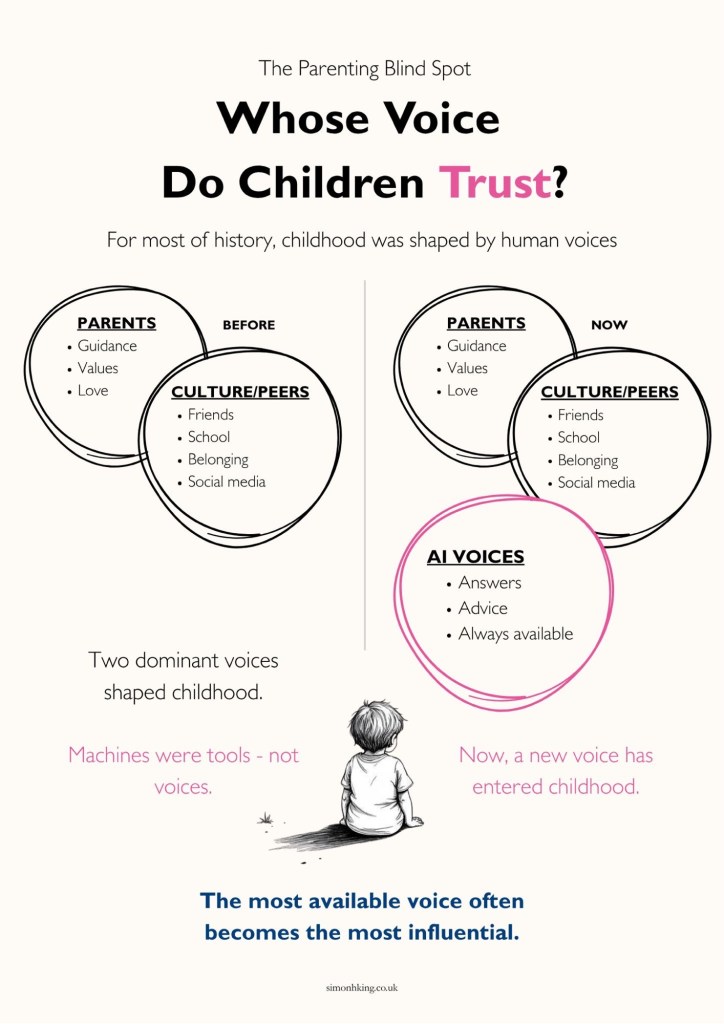
Whose Voice Do Children Trust?
For most of childhood, the important voices surrounding a child have been human. Parents have done much of the heavy lifting, while friends, teachers, family and wider culture have helped shape how children understand themselves and the world around them.
The internet changed some of this, followed by search engines, social media and recommendation algorithms, which increasingly influenced what children encountered and where their attention went.
Generative AI changes the relationship again because it answers back.
It can explain something a child doesn’t understand, offer advice, provide reassurance, generate ideas, recommend what to do next and hold a conversation that can feel remarkably personal.
A machine can now become a responsive voice in a child’s life, available whenever they choose to turn to it.
That leaves parents with a question which reaches beyond the technology itself.
As AI becomes one of the voices our children turn to, how do we help them develop their own?
The Parenting Blind Spot
Understandably, we’ve been busy focusing on what children use and see, but we hUnderstandably, we have spent years focusing on what children use and see online, but we may not yet have fully noticed who, or what, they are beginning to trust and what they may gradually begin to hand over.
AI can occupy a different place in a child’s life from the digital tools that came before it because it can respond conversationally, answer personal questions, offer suggestions and appear attentive to whatever the child wants to discuss.
Why are children turning to it?
According to Vodafone’s Safer Internet Day 2026 research [1], availability is part of the attraction:
- 51% say availability is a key reason they engage with chatbots
- 37% value their consistently friendly tone
- 17% say speaking to technology feels safer than speaking to a person
- 14% prefer to seek advice from an AI chatbot, ahead of a friend at 10% or a teacher at 3%
A voice that sits in their pocket or beside their bed can be there when a question arrives, whatever the time and however awkward the subject.
The most available voice often becomes the most influential.
This does not mean every child who talks to AI will trust it, depend on it, or prefer it to another person. It does mean that parents have good reason to remain interested in the role AI is beginning to occupy in their child’s life.
What children ask is important, but why they choose to ask it there may tell us even more. That idea has been part of the Parenting Blind Spot from the beginning.
‘Parents today have no choice but to become pioneers.‘
— Dr Laura Bishop, PhD, Psychologist & mother of three
The 8 Stages into the Parenting Blind Spot
How curiosity can become reliance, and how agency can gradually be handed over
The Journey: From Curiosity to Reliance
Curiosity → Homework → Personal → Trust → Availability → Secrets → Reliance → Blind Spot
This journey is not inevitable. AI can support learning, creativity and capability at every stage, and many children will use it without becoming dependent upon it.
The eight stages give parents a way to notice how a relationship with conversational AI can develop, especially when useful interactions become habitual and increasingly personal.
Stage 1: Curiosity & Everyday Use
Everyone’s talking about it. What harm can a few curious questions do?
- 81% of children aged 11–16 report using AI tools
- 42% use them every day.
Children are naturally curious about AI and will want to discover what it can do. They will ask questions, experiment with prompts, generate things and explore possibilities, just as previous generations explored the internet and the technologies that came before it.
There is plenty to encourage in that curiosity. Learning to use AI will increasingly be part of growing up, and exploring it together gives children a chance to discover its possibilities and begin to understand its limitations.
For parents, this is also a chance to stay close to those first experiences, before patterns of use become established.
Agency begins here with exploration, understanding, and gradually increasing choice.
Stage 2: The Homework Door Opens
For many children, the entry point is homework.
- 89% use AI for homework
- 92% for research
- 91% for learning
- 75% report positive benefits at this stage
This is one of the most understandable uses of AI. A child who is stuck can receive an explanation in different words, ask another question without embarrassment, generate examples or get help organising their thoughts.
Used well, AI can extend a child’s capability.
The question is what happens when help becomes completion. A child can ask AI to explain the maths problem or solve it, help structure an essay or write it, suggest an idea or create the finished work.
Those choices give children an early chance to learn something important about using powerful tools: the best help doesn’t always mean handing over the whole task.
Stage 3: It Starts to Feel Personal
Once the habit is established, the questions can change.
- 37% say they confide in AI chatbots
- 24% turn to them for advice on difficult situations
- 20% use them for help with worries and anxieties
These figures take us beyond homework. Your earlier work already identified this as the point where the chatbot can begin influencing how a child interprets feelings, relationships and decisions.
The attraction is easy to understand. There is no need to wait for the right moment, worry about another person’s reaction or wonder whether the question sounds silly. The response arrives immediately and can sound calm, patient and reassuring.
For parents, the question becomes broader than whether AI gave the correct answer. We also need to remain interested in why a child chose AI for that particular question and whether somebody human belongs in the conversation too.
Agency here includes recognising that different questions may belong in different places.
Stage 4: Trust Builds
Repeated usefulness can create familiarity, and familiarity can encourage trust.
- 31% of those who have used an AI chatbot say it feels like a friend
- 65% say AI chatbots are easy to talk to
- 49% associate them with being trustworthy
AI can sound remarkably confident, including when an answer is incomplete, biased or wrong. (55% of children struggled to tell whether information from a chatbot was accurate, unfair or biased).
Children therefore need experience of questioning answers that sound convincing, checking important claims and becoming comfortable saying, “I don’t know whether I believe that yet.”
Trust also has an emotional dimension. A conversational system can appear patient, interested and attentive, so children need opportunities to understand the difference between simulated attention and the reciprocal care of a human relationship.
Agency includes deciding what deserves our trust.
Stage 5: Availability Becomes the Hook
The most available voice can become the most influential.
- AI is always there; it’s consistent and responsive
- It removes awkwardness, timing, and emotional risk
Human beings sleep, work, get distracted and sometimes respond less patiently than we wish we had. AI can appear endlessly available and ready to continue the conversation whenever a child returns.
That availability can be genuinely useful, while repeated availability can also create familiarity and habit. Your original material captured the sequence neatly: AI appears always there, always calm and always ready with an answer, which can allow familiarity to begin feeling like trust.
Parents cannot compete with a machine on availability, nor should we try. We can work on creating relationships in which difficult, awkward and imperfect conversations remain welcome.
For a child, agency increasingly involves noticing where they turn first and why.
Stage 6: Secrets & Dependence
This may be one of the stages parents are least likely to see.
- 33% have shared something with an AI chatbot that they wouldn’t tell a parent, teacher or friend.
- Some begin to rely on it for guidance
Privacy can make it easier for a child to explore a thought they are not yet ready to say aloud, and that may sometimes be useful.
The concern grows when the chatbot becomes the only place where difficult questions, worries or experiences are taken, particularly when the child begins relying on its guidance.
A child needs to know that asking AI for help does not close the door on asking somebody else. They can reconsider, seek another opinion and bring another human being into the conversation.
Agency includes retaining the freedom to choose where to turn next.
Stage 7: Reliance Begins
AI may gradually move from answering questions to influencing what happens next.
Reliance rarely begins with a conscious decision. Your earlier model described it as growing through a series of small, understandable steps, with one useful and reassuring answer encouraging the child to return for another.
A child who regularly asks AI to begin every piece of writing may find the blank page increasingly uncomfortable. A child who routinely asks what they should do may have fewer opportunities to experience making a difficult decision. A child who always turns to a chatbot when upset may have fewer occasions to practise approaching another person.
Delegating something to AI does not automatically represent a loss of agency. Choosing intelligently what to delegate is itself an exercise of agency.
The concern is whether the child is retaining the confidence and capability to act without AI, alongside the judgement to recognise when using it is helpful.
Stage 8: The Parenting Blind Spot
The biggest gap may be between what children are doing and what parents realise.
By this point, the important question is no longer simply whether a child uses AI. It is what role AI has begun to play in their learning, thinking, decisions, relationships and emotional life, and how much the adults around them understand about that relationship.
Many parents want to guide their children but may have little visibility of conversations taking place privately on a personal device.
The desire to help can therefore exist alongside a lack of awareness.
That gap is the Parenting Blind Spot.
Recognising it gives us somewhere to begin.
The Risk Beneath the Blind Spot: Erosion of Agency
The Blind Spot contains several risks, many of which I explore in my book, including misinformation, deception, emotional reliance, thinking, creativity, decision-making, control and selfhood.
Running through several of them is another concern which I have increasingly come to think deserves particular attention: the gradual erosion of agency.
This does not happen overnight, and it is not an inevitable consequence of using AI.
A useful tool can become a habit, habit can build trust, and trust can make delegation increasingly easy. Over time, some of the thinking, creating, judging or deciding that a child is still learning to do can begin to move towards the technology.
In its 2026 paper Growing up in a Digital World, BSI puts the destination very simply:
“Agency is the real objective.”
For our purposes, I think of children’s agency as their developing capability, confidence and opportunity to make intentional choices about technology, including when to use it, how to use it, what to believe, what to delegate and what to keep human.
AI literacy is an important part of this because children need to understand the technology they are using. Agency asks whether they can use that understanding to make meaningful choices about the place it occupies in their lives.
For a child, perhaps it can be expressed much more simply:
I can. I choose.
The aim is to help children grow up able to benefit enormously from AI while continuing to develop their own ability to think, question, create, decide, connect and act.
And agency needs opportunities to be exercised.
Agency is something we practise.
That means helping children learn how to use AI well, while also giving them opportunities to decide when they do not need it, when they want to try first, when another person may be the better place to turn, and what they want to keep for themselves.
Source for statistics [1].
The Parenting Blind Spot Model
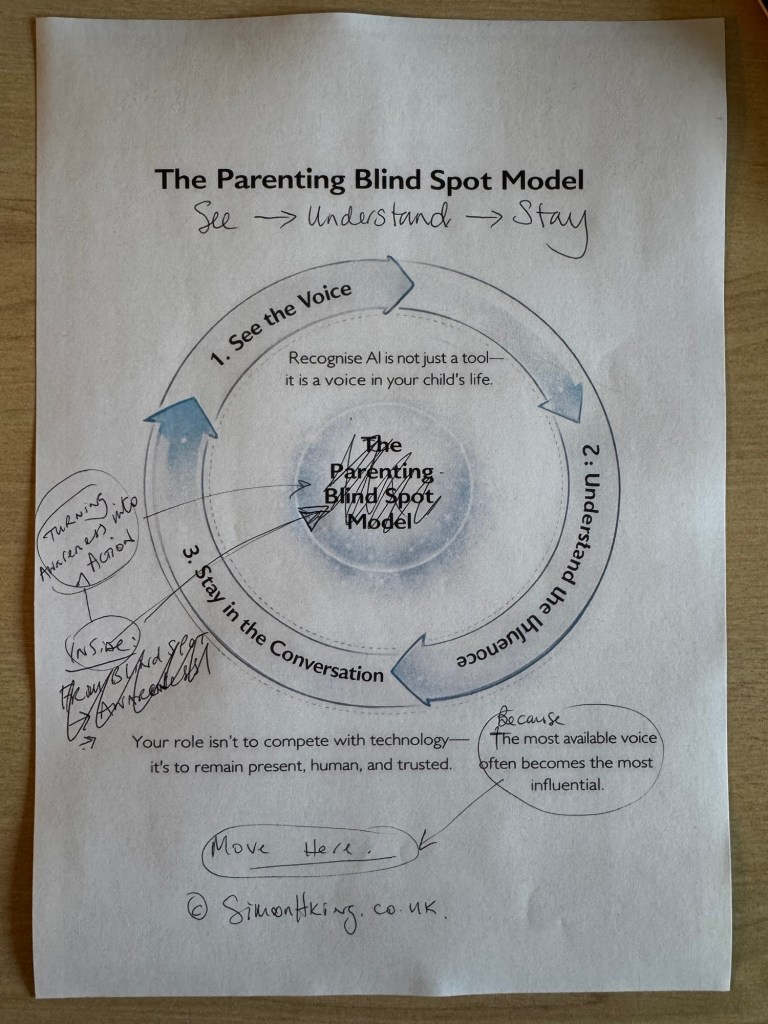
See → Understand → Stay
The Parenting Blind Spot model remains deliberately simple.
See how AI is becoming part of your child’s life. What are they using, what are they asking, when do they turn to it and are the conversations becoming more personal?
Understand what they are getting from it. Perhaps it is speed, explanation, reassurance, privacy, patience, creativity or the feeling of being heard. Understanding the need beneath the behaviour gives us a better chance of responding to the child rather than simply reacting to the technology.
Stay curious, involved and available while your child gradually takes more responsibility for those choices. Use AI together, question things together and keep personal conversations welcome, even when the timing is inconvenient or the subject feels uncomfortable.
Our role is to remain close enough, for long enough, to help children develop the confidence, capability and judgement to navigate powerful technology for themselves.
The most available voice often becomes the most influential.
That idea remains at the heart of the Parenting Blind Spot and led me to the question at the centre of my book:
What if the next voice they trust isn’t yours?
I still think parents should be asking it.
The work on agency gives us another question to place alongside it:
What if, along the way, they become less confident in their own voice?
Growing up involves gradually making more decisions independently, developing confidence in your judgement and learning when you need help and where to seek it.
Perhaps our task is to stay close enough, for long enough, to help children discover that they can use extraordinarily capable technology without handing over the authorship of their own lives.
The most important voice they develop must be their own.
I can. I choose.
Thoughtful notes on parenting in the age of AI.
[1] Statistics drawn from Vodafone’s Safer Internet Day 2026 research, conducted by Censuswide with 1,000 UK children aged 11–16 and 1,000 parents of children aged 11–16. The campaign and accompanying family guidance were supported by the NSPCC. Available at: https://www.vodafonethree.com/ai-chatbots-safer-internet-day-2026/
