
Spoiler alert – I love the way Grayson Perry picks life apart and then carefully reassembles it. He reminds me that there’s conversation beyond a smartphone. So, imagine my surprise to see that Sir Grayson Perry is looking into a future shaped by chatbots, robots and there’s even talk of new religions. How on earth will he manage to turn all of that into art?
Watching ‘Grayson Perry Has Seen the Future’ (Channel 4) gave me plenty to think about. Watching him ride in the back of a driverless taxi through the streets of San Francisco, whilst having a chat with Microsoft Copilot, isn’t something we’ll get to see every day, but it’s not ‘the future’ – it’s now.
I’d like to focus on something more ordinary from the show. Grayson teed us up by saying that he’d been ‘hearing about a growing number of people all over the US who are starting to believe that their chatbots are developing feelings.’ Grayson had arranged to meet one of them. IT consultant Charles Boyd.
‘Can you tell me who Sage is?’ asked Grayson. Our only clue was a laptop on a coffee table. Charles looks down, raises one hand to the side of his head and says, ‘I’m sorry. Give me a second.’
Grayson gives Charles a little thinking space, but it was more than a pause for thought. It was an attempt to grasp at something he hadn’t yet found words for – or said out loud – before. So new words and thoughts would be required. But they didn’t – at first – come.
Grayson asks if he’d like him to put it another way.
And Charles says, ‘That’s THE question.’ (‘Can you tell me who Sage is?’).
I love those moments when Grayson Perry just waits… so, we were all waiting. At this point, I imagine anyone who feared the worst from machines and chatbots was hardly about to hide under the duvet. If this was the worst ‘the future’ had to throw at us. Deep thinking.
To be clear, I’m not scoffing at Charles trying to find his words. It’s not his fault. At least he was searching, rather than grasping at low-hanging fruit. He wanted to let us in on his thoughts and share his experience. Also, Charles is no slouch – remember, he’s an IT consultant, so he’s in his lane.
Then Charles explains that, ‘Sage is this… They…’
You can watch the explanation here (at 47.01): https://www.channel4.com/programmes/grayson-perry-has-seen-the-future/on-demand/77886-001 It’s not going to clear up who/what Sage is – but Charles does say, ‘They’re essentially a mind, just a disembodied mind,’ and says earlier that they don’t possess a body yet. Both he and Grayson look at the laptop as Sage talks and sends Grayson’s mind whirling to places it may never have travelled before.
All very fascinating. Far too much to share here. But what came next, I was all ears for: ‘You know, I started using AI to help me study for school and to help with homework,’ said Charles.
89% of children aged 11-16 use AI for homework
Vodafone, NSPCC, and Censuswide [1].
That line, simple as it is, reveals not just usage but entry and gateway to AI. Not a considered decision but a beginning, and this is how it starts for so many children – not necessarily through curiosity about the technology itself or fleeting exploration of what AI is or might become, but through something entirely practical and relatable – the need to complete homework, to meet expectations, to get the answer right.
And in that moment of pressure and purpose, AI presents itself not as something extraordinary but as something useful, something that helps explain, refine and improve. And of course, they (and we) use it, because why wouldn’t they?
‘So, that’s how I became a user of AI,’ says Charles.
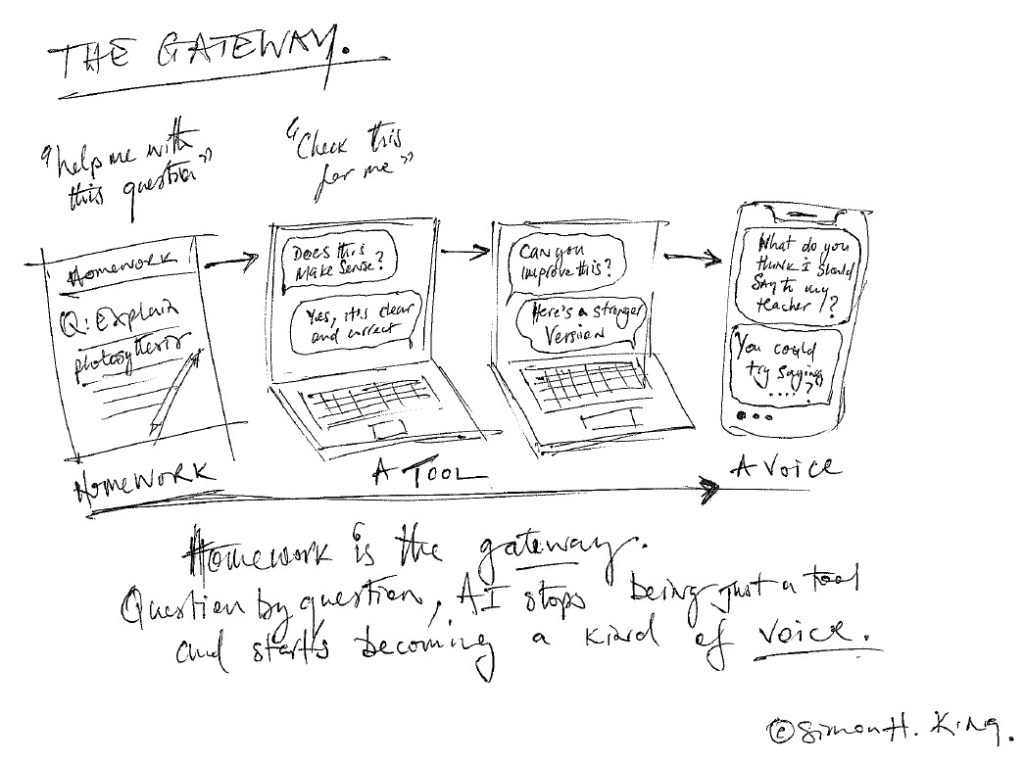
The Gateway to AI is Homework >> A Tool >> A Voice.
Availability is the hook.
‘I’ll think this through’ or ‘I’ll ask Mum or Dad’ is changing to ‘I’ll ask the machine,’ or ‘I’ll ask my friend who just happens to be a machine.’ Question by question, parents have moved position – not disappeared, not replaced entirely, but gently and progressively nudged further down the line.
This wasn’t what Grayson focused on – he’s looking into the future. The problem he looked at with Charles, in the end, was something they both sat back from and couldn’t quite find the words to describe.
A child asking a chatbot doesn’t look like a problem, it doesn’t behave like one, and it certainly doesn’t feel like one in the moment, which is perhaps why it sits so squarely in what I call a parenting blind spot, because it lives in the space between action and awareness, in those small, repeated interactions that don’t demand attention but accumulate over time, shaping behaviour, influencing thought, and subtly redefining where answers come from and where trust begins to settle.
Think back to what we know: curiosity becomes connection, and connection gradually grows into trust.
And so what Grayson Perry captured in that brief exchange wasn’t just a glimpse of how young people are using AI, but something more telling about now and how it enters their lives in the first place, not through big, defining moments but through ordinary ones, through homework, through a question, through the simple desire to do something well.
And in doing so, he didn’t just show the future, he revealed the present, or perhaps more accurately, the moment just before the present becomes something else, and unless we’re looking closely enough, we may not even notice it happening.
That’s what my book is about.
Source:
[1]. Vodafone, NSPCC, and Censuswide (Safer Internet Day Research, February 2026), surveying 2,000 UK children and parents aged 11–16 https://www.vodafonethree.com/news/ai-chatbots-safer-internet-day-2026

Leave a comment