Why? The Parenting Blind Spot
Why Our Children Need Us More Than Ever
Your child has a question.
But the chances are, they won’t ask you – they’ll ask a machine.
It responds immediately – it’s clear, composed, and sure of itself. That clarity is addictive.
This isn’t a future problem. It’s already happening.
Today, 81% of children aged 11-16 now use AI chatbots in their daily lives, and almost a third see them as ‘friends.
Vodafone, NSPCC, and Censuswide [1].
As life’s questions become more complicated, it can start to feel like the safer place to turn is a machine. After all, we’ve been telling our children to ‘Google it’ for years – why would they stop now?
Whose Voice Do Children Trust?
For most of history, childhood has been shaped by human voices.
Parents have done much of the heavy lifting, offering guidance, helping to instil values, and nurturing their children with love and building trust.
Culture and peers in the shape of friends, school and good teaching, social norms, and, in more recent years, social media have shaped belonging and identity. Although few would argue that social media has introduced new challenges and heartache. It has, however, also created connections. There’s no doubt that it shapes childhood.
Machines have already influenced what children see through algorithms, feeds, and search. But in those guises, they were tools that didn’t speak or respond, and they didn’t feel like a voice we could have a conversation with.
That’s changed.
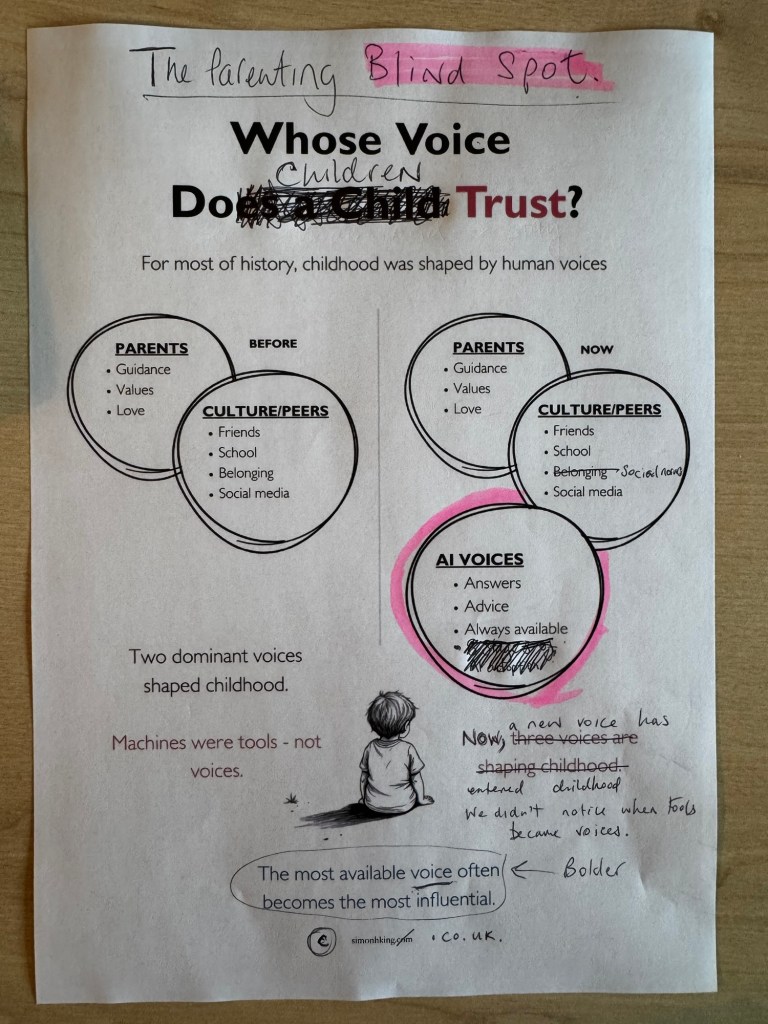
The Parenting Blind Spot
Understandably, we’ve been busy focusing on what children use and see, but we haven’t fully noticed who – or what – they’re starting to trust.
AI isn’t just a tool.
It’s not a calculator.
We’re already seeing how quickly this is happening.
It’s a voice in a child’s life, and it’s time to recognise that fact.
Why are children turning to it?
According to Vodafone, NSPCC, and Censuswide [1]:
- It’s always available
- It’s calm and responsive
- It’s non-judgmental
A voice that sits in their pocket. By their bed. There when the questions won’t go away, whatever time they arrive.
And when a voice is always available, more available than a parent, teacher, or friend, it becomes increasingly influential.
Research courtesy of Vodafone, NSPCC, and Censuswide (Safer Internet Day Research, February 2026), surveying 2,000 UK children and parents aged 11–16, supports this [1].
- 51% say availability is a key reason they engage with chatbots
- 37% value the consistently friendly tone
- Nearly 1 in 5 (17%) say speaking to technology feels safer than speaking to a person
- With 14% preferring to seek advice from an AI chatbot, ahead of a friend (10%) or teacher (3%).
And much of this is happening out of sight, but under our noses.
What matters most isn’t just what children are asking, but why they’re asking it there.
The 8 Stages into the Parenting Blind Spot
How curiosity becomes reliance, and how parents lose their voice
The Journey: From Curiosity to Reliance
Curiosity → Homework → Personal → Trust → Availability → Secrets → Risk → Blind Spot
Stage 1: Curiosity & Everyday Use
Everyone’s talking about it. What harm can a few curious questions do?
- 81% of children aged 11–16 report using AI tools
- 42% use them every day.
Stage 2: The Homework Door Opens
The entry point for many children is homework.
- 89% use AI for homework
- 92% for research
- 91% for learning
- 75% report positive benefits at this stage
Stage 3: It Starts to Feel Personal
Once the habit is established, the questions change.
- 37% begin to confide in AI
- 24% turn to it for advice or emotional support.
Stage 4: Trust Builds
With repeated use, familiarity becomes trust.
- 31% describe AI as friend-like
- 65% say it feels easier to talk to than people
Stage 5: Availability Becomes the Hook
The most available voice becomes the most influential.
- AI is always there — consistent and responsive
- It removes awkwardness, timing, and emotional risk
Stage 6: Secrets & Reliance
This is the stage most parents don’t know exists.
- 33% of children share things with AI they don’t share elsewhere
- Some begin to rely on it for guidance
Stage 7: The Risks Hidden in Plain Sight
Children begin making decisions based on AI guidance — without fully understanding its limits.
- Not all children can confidently judge accuracy or bias
- Educators are already noticing changes in independent thinking
Stage 8: The Parenting Blind Spot
The biggest risk may be the gap between what children are doing and what parents realise.
- Many parents remain unaware of how AI is being used emotionally
- Yet most want to be actively involved in guiding their children
The desire is there.
The awareness isn’t.
That gap is what this book is here to close.
Ready to stay the voice your child trusts most?
Source for statistics [1].
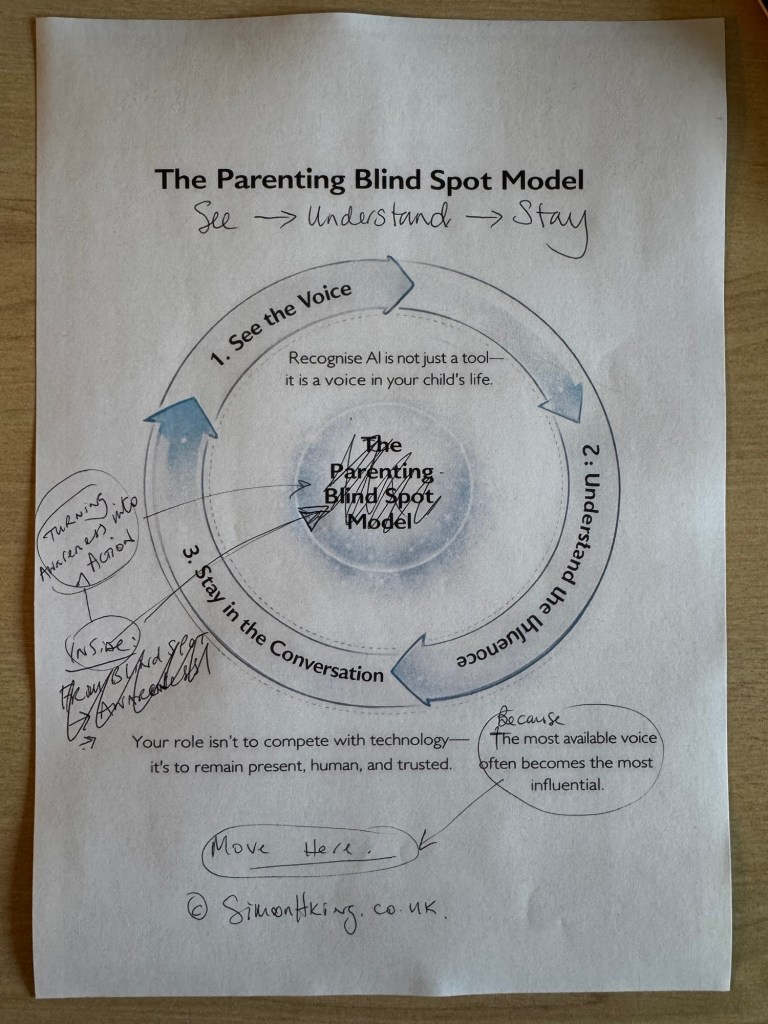
The Parenting Blind Spot Model
See → Understand → Stay
If you can see where your child is in their AI journey, you can understand its influence and stay in the conversation long enough to remain part of their world.
Our role isn’t to outdo technology, but to maintain a strong, trusted, and human connection with your child.
Because…
The most available voice often becomes the most influential.
AI will shape how our children think.
Emotional intelligence shapes who they become.
The most important voice in their life must still be ours.
Ready to stay the voice your child trusts most?
Or join other parents thinking about the same questions.
[1]. All statistics courtesy of Vodafone, NSPCC, and Censuswide (Safer Internet Day Research, February 2026), surveying 2,000 UK children and parents aged 11–16 https://www.vodafonethree.com/news/ai-chatbots-safer-internet-day-2026
